Critical Minerals

The global demand for critical minerals—such as nickel, copper, cobalt, manganese, and rare earth elements—is accelerating, driven not only by the energy transition but increasingly by strategic industries including defense, advanced manufacturing, and digital infrastructure.

Electric vehicles, wind turbines, and battery systems remain key drivers, but critical minerals are also essential for high-performance alloys, secure communications, and advanced sensor technologies used in aerospace and defense. According to the IEA’s latest analysis, demand for nickel, copper, and cobalt is expected to more than double by 2040, with supply chains facing increasing pressure from both industrial growth and geopolitical uncertainty.

While terrestrial mining remains part of the solution, many new prospects are located in ecologically sensitive or politically unstable regions. Moreover, declining ore grades, waste challenges, and ethical concerns continue to limit scalability. At the same time, China maintains a dominant position in the global supply chain—controlling over 90% of refining capacity for rare earths and graphite, and a significant share in cobalt, nickel, and copper processing.

This concentration poses risks to supply chain resilience and national security. The U.S. Department of Defense has identified critical minerals as foundational to industrial and strategic autonomy, yet remains heavily import-dependent—particularly on China. As geopolitical tensions rise, securing diversified and resilient sources of these materials has become a strategic imperative.

Glomar Minerals is committed to advancing deep sea mineral sourcing as a reliable and geopolitically independent pathway to meet the growing demand for critical resources—supporting industrial resilience, technological innovation, and strategic independence.

Global Critical Minerals Outlook 2025

Deep sea minerals – global occurrences

Three main deposit types of deep sea minerals exist: manganese nodules and  manganese crust which are both found in the deeper part of the oceans and seabed massive sulphides which are found close to the spreading ridges.

Critical minerals are abundant in marine deposits and can secure supply with a low environmental footprint. Deep sea minerals have significantly higher enrichment compared to terrestrial resources and both manganese nodules and crust have no toxic waste.

Largest remaining resources

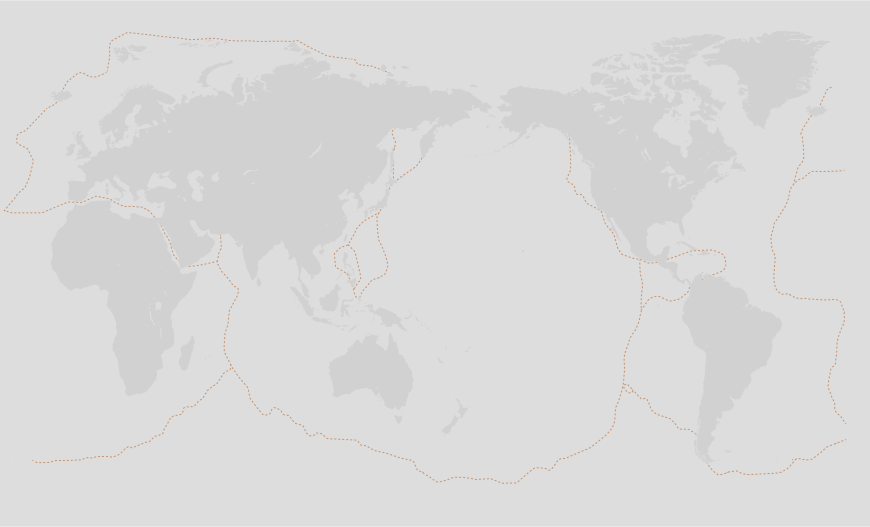
Global distribution of deep sea minerals

Filter by source:

Manganese nodules

Occurs throughout the global ocean, predominantly on the surface of sediment-covered abyssal plains at water depths of approximately 3500 to 6500 m. Most nodules are partly submerged in the sediment and vary in diameter from 2 cm to 20 cm.

Manganese nodules grow by accumulation of Mn and Fe oxides around a nucleus. Unlike manganese crusts, nodules acquire metals from two sources ambient seawater (hydrogenetic) and sediment pore waters (diagenetic).

Key minerals are nickel, cobalt, copper and manganese. 

Manganese Crust

Crust forms through precipitation on surfaces in the ocean like seamounts, ridges, and plateaus as pavements and coatings on rocks in areas that are kept sediment-free for millions of years.

Crusts are found typically at water depths of 400–7000 m. with the thickest and most metal-rich crusts occurring at depths of about 800–2500 m. Crusts vary in thickness from 1 to 260 mm and are generally thicker on older seamounts.

Key minerals are cobalt, nickel, copper, manganese and REE.

Seabed Massive Sulphides (SMS)

Forms on mid-ocean ridges, in back-arc basins and along submarine volcanic arcs. SMS deposits form through hydrothermal activity; cold sea water percolates down through the seafloor, is heated through geothermal energy, becomes buoyant and rises, dissolving metals and sulphides from the surrounding rocks.

Rapid precipitation of metal sulphides leads to chimney formation, with chimney collapse and coalescence forming sulphide mounds.

They usually form in water depths between 1000 and 4000 metres and are active for several tens of thousands of years. It is only extinct SMS that are targeted for mining.

Key minerals are copper and zinc plus potential high concentrations of gold and silver.